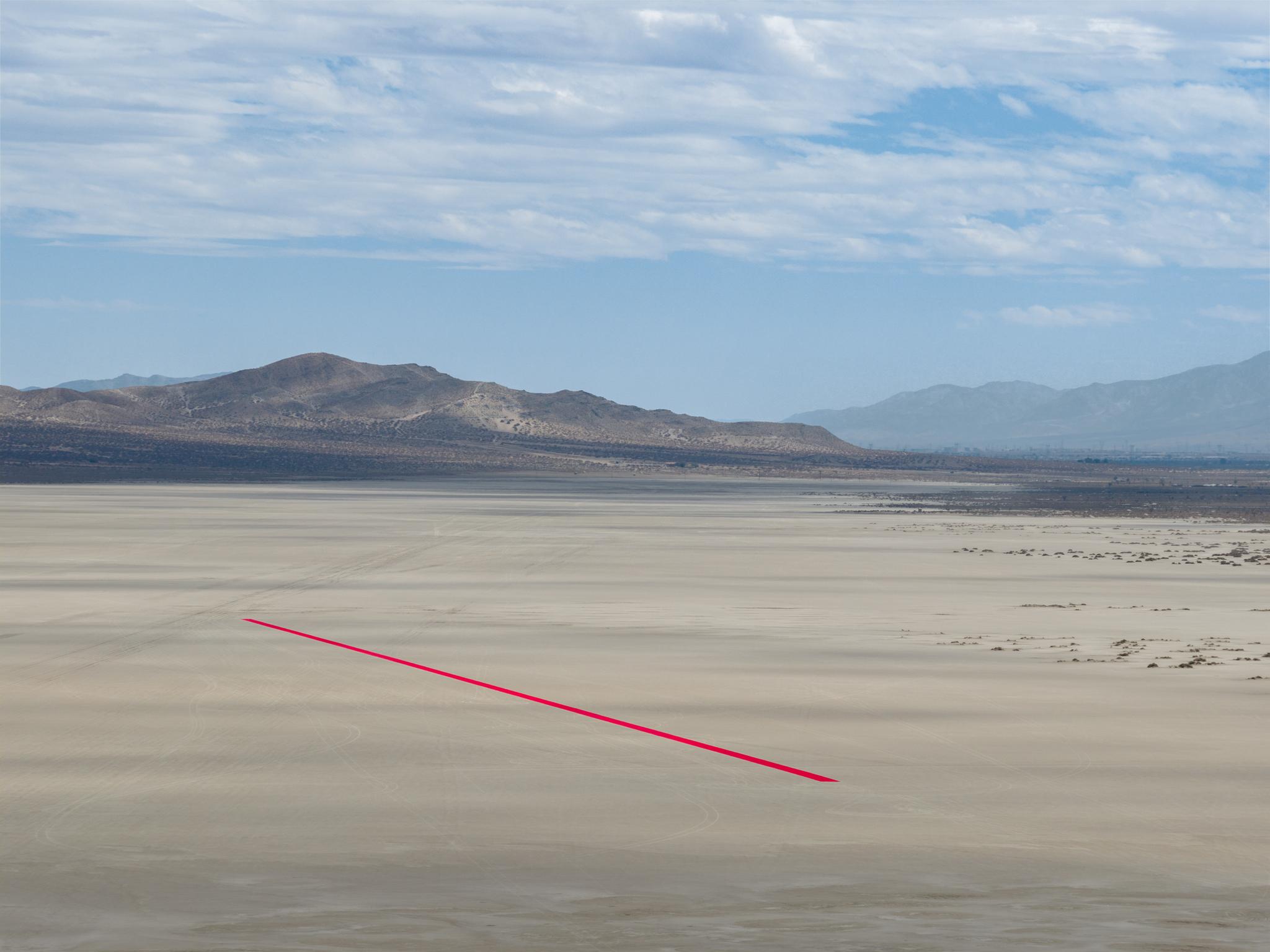
On the dry lakebed of El Mirage in California, Gregory Orekhov unfurls a red polypropylene carpet that extends for one kilometer, following an east–west axis that traces the movement of the sun from sunrise to sunset. The red line cuts across the cracked surface of the desert, forming a precise geometry in which a human being enters into a dialogue with the infinity of space.
In El Mirage, action becomes a statement of presence. The line stretched across the ground aligns the human scale with that of the landscape and remains visible through different states of light: at dawn — sharply defined and still, like the first stroke of a new day; at noon — almost dissolving into a mirage; by evening — as if filled with inner light, reflecting the sunset. Transforming from sunrise to sunset, the line loses its tangibility, turning into a metaphor of time and passage.
At the core of the work lies a reflection on human existence as a movement through the boundless expanse of the world. The red line becomes a manifestation of life itself, lived between beginning and end, the first light and the coming darkness. In the silent desert, where a person is left alone with space and wind, this path acquires an existential dimension: the effort to endure, to keep one’s direction, not to vanish into the mirage of one’s own reality. Like a trace left in a fragile world, the line embodies the human desire to be seen, if only for a moment, before everything is once again swallowed by silence.
The installation is connected to an earlier work Nowhere (2022), created by Orekhov in Malevich Park, where a red line extended across snow in a forest. Transferred from cold to heat, from east to west, from the tranquility of the winter forest to the barren desert, the form remains the same while its meaning changes. On snow, it was a “road to nowhere”, a deconstruction of a ceremonial gesture, a line fading into infinity; in the desert, it becomes a sign of presence, an axis mirroring the path of the sun, carrying the breath of life.
El Mirage is not merely land art, but a gesture of presence — a line in which faith, solitude, and the longing to leave a mark converge, even if that mark might disappear with the first gust of wind.
Photography: Rafael Gamo, Gregory Orekhov, Studiolandon